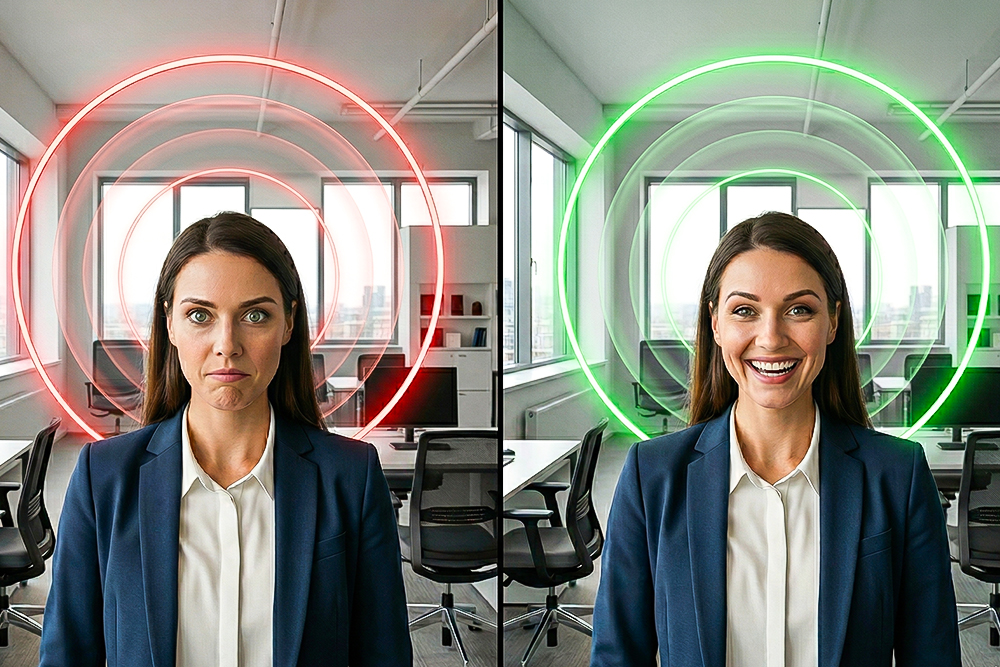
Positive vs. Negative Intuitive Signals: How to Tell the Difference
Your intuition is always speaking. The question is not whether you are receiving signals; you are, constantly, across all four intuitive types simultaneously. The question is whether you are reading them accurately.
Because intuition speaks in two directions.
Positive intuitive signals are the felt sense that a decision, a person, a direction, or a moment is genuinely aligned. They feel calm and clear. They do not require self-hype or external validation. The decision simply fits, and you know it fits in the same quiet way you know a key is the right one for a lock before you turn it.
Negative intuitive signals are the felt sense that something is off. They feel like tightening, unease, a vague wrongness you cannot precisely locate, a recognition that something does not add up even when everything on the surface looks fine. They are your cheapest moment to act, the moment when the correction is still a conversation rather than a restructuring.
The problem is not that entrepreneurs lack access to these signals. The problem is that the two are frequently confused, and that the most expensive business mistakes happen when negative signals get misread as positive ones, or when positive signals get dismissed as naive optimism.
What Positive Signals Actually Feel Like
The popular image of intuitive confidence is wrong. It is not a dramatic flash of certainty. It is not a feeling of invulnerability or excitement. Those feelings are often associated with ego, adrenaline, or the social pressure of other people’s enthusiasm, and they can masquerade as positive intuitive signals while being something quite different.
Genuine positive intuitive signals have a specific quality: they are quiet.
A decision that your four intuitive types have genuinely approved does not feel exciting in a charged way. It feels settled. The kind of settled that does not need to be talked up or validated externally. You can describe the decision clearly without overselling it. It does not require a performance of confidence; it simply carries it.
This is what Sunil Godse describes in Build Trust. Become the Brand. as the positive signal: “A green signal feels calm and clear, with no self-hype needed, as it simply fits. Decisions land faster, and the team senses conviction without long explanations.”
The other marker of a genuine positive signal is that it tends to be consistent across multiple intuitive types simultaneously. When your Experiential Intuition says this pattern is familiar and the outcome is good, your Relational Intuition says the people involved feel genuinely aligned, your Situational Intuition says the timing and readiness are right, and your Creative Intuition says the direction is sound, that convergence is a strong signal to move with confidence.
What Negative Signals Actually Feel Like
Negative intuitive signals are trickier, not because they are subtle, but because they are easy to explain away.
The first level is the early warning: a quiet tightening or unease that arrives before the problem is visible in any metric. This is your cheapest moment to act. The correction at this stage is still a conversation, a closer look, a deliberate pause before committing. The problem is still small, and the options are still many.
This is the stage where most entrepreneurs make the mistake that costs them later. The tightening is present. The unease is real. But the pressure, such as to close the deal, to make the hire, to ship the product, is louder than the internal signal. And the signal is quiet enough that it can be explained away as nerves, as risk aversion, as the normal discomfort of ambitious decisions.
The second level is what happens when the early warning is ignored long enough. The signal is no longer quiet or deniable. It is visible in the metrics, felt throughout the organization, and now requiring expensive emergency response rather than the cheap early correction that was available months earlier. What would have cost a conversation in month two now costs a restructuring in month fifteen.
The goal is always to catch the signal early because the cost differential between acting at that stage and waiting for the situation to force your hand is significant. Decision-making researchers have documented consistently that acting on early warning signals produces substantially better outcomes than waiting for data confirmation that arrives too late for affordable correction.
The Most Common Misreads
Adrenaline as a positive intuitive signal. The excitement that comes with a new opportunity, like the energy of a big deal on the table, the social pressure of other people’s enthusiasm, and the charged feeling of moving fast, can feel like a positive intuitive signal. It is often not. Adrenaline is a stress response. Excitement is an emotional state. Neither is the same as the quiet, settled certainty of a genuine positive signal. Entrepreneurs who confuse adrenaline for intuition tend to make expensive decisions that felt exciting in the moment and costly in the aftermath.
Fear as a negative intuitive signal. Not every uncomfortable feeling is Experiential Intuition firing a legitimate warning. Some discomfort is simply the normal anxiety of ambitious decisions: the unfamiliarity of a new direction, the vulnerability of commitment, the ordinary fear of failure that accompanies any meaningful choice. Treating all discomfort as a negative intuitive signal produces paralysis rather than protection. The distinction is specificity: genuine negative signals tend to be specific as they point at something particular, while anxiety tends to be general and undirected. Psychologists who study intuition have identified this distinction between genuine signal and anxiety as one of the most practically important in decision research.
Confirmation bias as all four types. Perhaps the most dangerous misread is when a strong creative conviction, or a strong desire for a particular outcome, generates the felt sense that all four types are aligned when they are not actually being consulted honestly. This is the mechanism that drove Quibi’s $1.75 billion failure: the creative conviction was so strong that the other signals were not genuinely heard, and the felt sense of alignment was manufactured by the conviction itself rather than generated by honest consultation of all four types.
A Practical Framework for Reading Your Signals
Before any significant decision, a structured check of your four types can help distinguish genuine signal from noise.
Check Experiential: Am I recognizing a pattern here, either positive or negative, from my past? What does my accumulated experience say about situations that look and feel like this one? Is the discomfort I feel rooted in a specific past experience, or is it general anxiety about the unfamiliar?
Neuroscientists who study how the brain encodes past experience have found that pattern-based intuitive signals are processed in fundamentally different neural pathways than general anxiety, which is why they feel qualitatively different once you learn to pay attention.
Check Relational: What is the energy of the people involved in this decision? Is the alignment genuine or performed? Is there a signal in the room, such as a quality of conversation, an energy in meetings, a pattern of behavior, that does not match the official story?
Check Situational: Are both streams genuinely aligned: internal readiness and external conditions at the same time? Is the pressure to move coming from genuine alignment or from outside urgency?
Check Creative: Is the direction this decision points toward genuinely worth building, tested against the other types, or am I protecting a conviction from the signals that would refine it?
When all four types point in the same direction, move with confidence. When any one sends a warning, investigate before you commit. When you cannot tell the difference between the signal and the noise, that uncertainty itself is data, and the appropriate response is usually to slow down, not speed up.
The entrepreneurs who build the most trusted brands are not the ones who never receive negative signals. They are the ones who have developed the discipline to read both types accurately and to act on the negative ones while the correction is still cheap.
Your signal system is already running. The question is whether you are reading it…or explaining it away.
The framework above works best when you know which of your four types is most active in your decisions. The Intuition Scorecard shows you exactly where your signal system is strongest.
→ Related: The Four Intuitive Types → Related: What Is Brand Drift – And Is It Happening to Your Business Right Now? → From the book: Build Trust. Become the Brand.→ Chapter connection: Chapter 1 – The Onboard Radar → Chapter connection: Chapter 22 – Learning to Recognize Your Positive and Negative Intuitive Signals