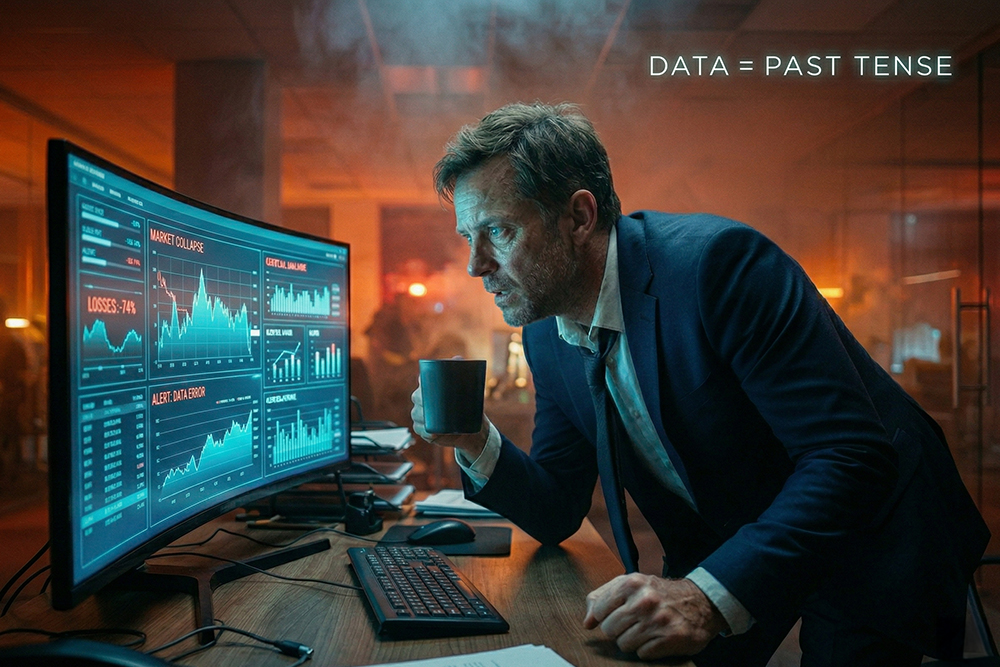
Why Data Will Always Arrive Too Late to Save Your Brand
Here is the uncomfortable truth about data-driven decision-making that no one in business school will tell you.
By the time your metrics confirm that something is wrong, the most expensive part of the problem has already happened.
The trust has already leaked. The culture has already shifted. The customers have already started drifting. The team has already started managing up instead of solving problems. The momentum that took two years to build has already started its quiet reversal.
The dashboard just has not caught up yet.
Data Is a Rearview Mirror
Data tells you what already happened. It is inherently retrospective: a measurement of past behavior, past performance, past decisions. By definition, it cannot show you what is happening right now at the level where problems actually begin, and it certainly cannot show you what is about to happen.
This is not a criticism of data. Data is essential. Financial metrics, customer behavior analysis, operational performance tracking: these are the instruments of a well-run business, and any entrepreneur who ignores them entirely is flying blind in a different and equally dangerous way.
But data has a lag. And the lag is where the damage happens.
MIT Sloan Management Review has noted in multiple studies on organizational decision-making that by the time performance metrics reflect a cultural or leadership problem, the underlying issue has typically been present for six to eighteen months. The metrics are not lying. They are simply measuring outcomes that were determined long before the measurement was taken.
Your intuition, by contrast, operates in real time.
Your brain processes signals from your environment, the energy in a room, the tone of a conversation, the felt sense of whether a relationship is genuine or performative, in approximately 33 milliseconds. Before a single data point has been recorded, your intuition has already run a pattern match against your accumulated experience and generated a signal.
The signal is early. The data is late. The most protected brands are built by entrepreneurs who have learned to act on the signal before they need the data to confirm it.
What the Dashboard Misses
Consider what a standard business dashboard actually measures.
Revenue. Margins. Conversion rates. Customer acquisition costs. Churn. Net Promoter Score. Employee satisfaction surveys. Quarterly performance reviews.
None of these measure the following:
- Whether the energy in your leadership meetings has shifted from genuine problem-solving to careful performance
- Whether the team member who scores highest on your engagement survey has quietly stopped believing in the mission
- Whether the long-term client who just renewed their contract is doing so out of momentum rather than genuine trust
- Whether the pattern of this new partnership mirrors the pattern of a relationship that cost you significantly three years ago
- Whether the market conditions that made your current strategy successful are quietly shifting beneath your feet
These are not soft observations. They are the actual leading indicators of every significant business problem, and they are invisible to every conventional measurement tool you have.
They are exactly what your four intuitive types are designed to read.
Your Relational Intuition reads the energy in rooms and relationships, the difference between genuine alignment and performed agreement, in real time, without a survey or a metric.
Your Experiential Intuition reads patterns from your accumulated experience — the recognition that this situation rhymes with a past situation that cost you, before the situation has developed far enough to show up in the numbers.
Your Situational Intuition reads timing and readiness, the felt sense that the foundation is not solid enough for the move you are about to make, before the premature move has been made and the damage is done.
These signals are early. The data that confirms them is late. The gap between the two is where every preventable business mistake lives.
The Facebook Lesson
Facebook’s privacy crisis did not begin with the Cambridge Analytica scandal in 2018. It began years earlier, in the internal rooms where engineers and product teams raised concerns about data practices that were dismissed as obstacles to growth.
The signals were present: in the energy of those rooms, in the pattern of user complaints, in the felt sense among employees that the gap between the company’s stated values and its actual practices was widening.
But the dashboard showed growth. Monthly active users were climbing. Revenue was accelerating. Every conventional metric said everything was fine.
By the time the data confirmed the problem, Facebook lost over $230 billion in market value in a single day. Daily active users declined for the first time in twenty years. The reputational damage took years to partially repair.
The signal was early. The data was catastrophically late.
Leadership experts have increasingly argued that intuition is a critical and undervalued skill in exactly these situations, where the most important data is not yet visible in any metric but is present and readable to anyone paying close attention. This is not a story about a uniquely reckless company. It is a pattern that plays out at every scale whenever leadership chooses the dashboard over the signal.
The Real Cost of Waiting for Proof
When a signal fires, which is a negative intuitive signal that something is wrong, you have three windows of action, each progressively more expensive than the last.
The signal window: The moment you feel the first unease. The cost of correction here is low. A conversation, a pause, a closer look. The problem is still small, and the options are still many.
The pattern window: The moment the signal has repeated enough times that deliberate dismissal becomes difficult. The cost of correction here is moderate. Some damage has been done, but recovery is still realistic.
The crisis window: The moment the data confirms what the signal knew months ago. The cost of correction here is high, sometimes catastrophically so. Options are limited. Trust has already eroded. The repair work is expensive, and the outcome is uncertain.
Almost every expensive business mistake in Build Trust. Become the Brand. happened in the crisis window, not because the signal was absent, but because leaders waited for the data to confirm what the signal already knew.
Sears felt the pull weakening long before the revenue numbers reflected it. Theranos scientists sensed the internal misalignment long before the regulatory collapse. MySpace designers raised alarms about user fatigue long before 96 percent of users drifted away.
The signal was always early. The decision to act on it was always deferred.
What This Looks Like in Practice
Using your intuition before the data catches up does not mean abandoning rigor. It means expanding your definition of what counts as a legitimate data source.
When a candidate’s answers feel rehearsed in a way you cannot specifically critique, that felt sense is data. Investigate it before you make the offer.
When a room goes quiet in a particular way after a difficult topic is raised, that energy shift is data. Address it before it becomes a culture problem.
When a long-term relationship starts using careful, managed language where it was once direct, that tonal shift is data. Have the conversation before it becomes a rupture.
When a new opportunity carries an urgency from the other side that does not quite make sense, that misalignment is data. Slow down before you sign.
None of these requires you to act impulsively on every uncomfortable feeling. They require you to treat your intuitive signals as the early warning system they actually are: running pattern checks, having honest conversations, and investigating what the signal is pointing at before the problem develops to the point where the dashboard notices it.
By then, the correction is always more expensive.
The most trusted brands in this book were not built by entrepreneurs who ignored data. They were built by entrepreneurs who understood that data explains the past and intuition protects the future, and who developed the discipline to act on both.
The dashboard is essential. Just do not wait for it to save you.
It always arrives too late for that.
→ Related: The Four Intuitive Types → Related: What Is Brand Drift — And Is It Happening to Your Business Right Now? → From the book: Build Trust. Become the Brand. → Chapter connection: Chapter 1 – The Onboard Radar