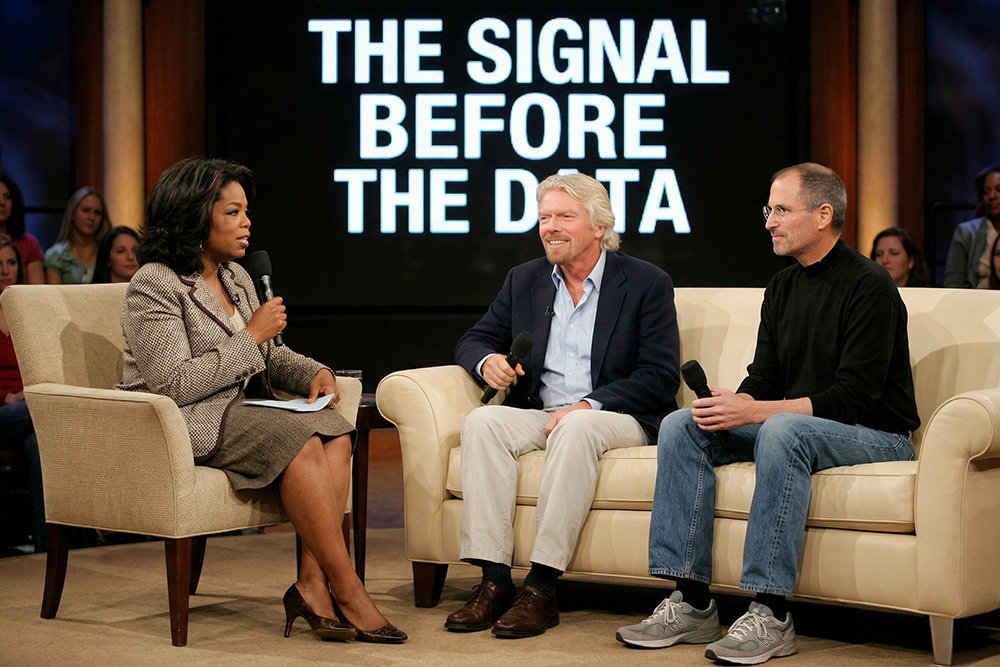
What Steve Jobs, Oprah Winfrey, and Richard Branson All Have in Common
“I began to realize that an intuitive understanding and consciousness was more significant than abstract thinking and intellectual logical analysis. Intuition is a very powerful thing, more powerful than intellect, in my opinion. That’s had a big impact on my work.” – Steve Jobs, Co-founder of Apple
“Trust your instincts. Intuition doesn’t lie.” – Oprah Winfrey, Entrepreneur and CEO, Harpo Productions
“If you’re going to go into a new business, it’s going to be successful based on your intuition.” – Richard Branson, Entrepreneur of the Virgin Group
Three of the most consequential brand builders of the last half century. Three industries. Three entirely different paths to building organizations that earned the kind of trust that compounds over decades.
And all three, when pressed to describe the decision-making system that drove their most important choices, pointed to the same thing.
Not data. Not advisors. Not best practices or industry consensus.
The signal that comes before the data. The felt sense of alignment or misalignment that fires before the analytical mind has assembled its argument. The intuition that, when trusted, built Apple, built Harpo Productions, built the Virgin Group.
This is not coincidence. And it is not mysticism.
Steve Jobs: Intuition as the Superior Intelligence
Jobs was not anti-data or anti-analysis. Apple’s supply chain, product development process, and retail strategy were as rigorously analytical as anything in business.
But Jobs was consistent and explicit across decades about the relationship between data and intuition in his decision-making: intuition was primary, analysis was secondary, and the decisions that defined Apple’s trajectory were almost always driven by a conviction that preceded any data confirming it.
The Macintosh. The return to focus that saved Apple in 1997. The iPod. The iPhone. The App Store. Each of these was a conviction that faced significant internal and outside resistance, that the data at the time did not clearly support, and that Jobs pursued because his intuitive signal was so strong and so consistent that the contrary evidence felt like noise rather than correction.
This is Creative Intuition at the highest level of development: the spark that sees what does not yet exist and the conviction that it should. But Jobs also exemplified the discipline that separates transformative creative conviction from expensive delusion: he tested the spark against the other types.
His Experiential Intuition was ferocious. The lessons from Apple’s early failures, like the Lisa, the original Macintosh’s limitations, and his exile from the company, informed every major decision he made after his return with a specificity and humility that his public image often obscured. He had scars, and he used them.
His Relational Intuition was legendary and controversial. Jobs’s ability to read people was acute. His ability to distinguish genuine talent from performed competence, genuine alignment from political agreement, was central to how Apple was staffed and how the culture was maintained.
In his 2005 Stanford commencement address, Jobs offered perhaps the clearest description of what this framework looks like from the inside: “Don’t let the noise of others’ opinions drown out your own inner voice. And most important, have the courage to follow your heart and intuition.”
The discipline Jobs described is developing the courage to trust your internal signal when outside voices and advisors say something different. That is not recklessness. It is the practiced skill of reading your own signal system accurately enough to know when it is worth trusting over the consensus.
Oprah Winfrey: Owning the Signal
Oprah’s story is one of the most instructive examples of Situational and Experiential Intuition in business history, not of creative vision, but of reading the convergence of signals and acting on them before the conventional wisdom caught up.
By the late 1980s, Oprah Winfrey had a hit talk show and a secure career path. The comfortable choice was straightforward: renew her contracts, comply with network direction, and continue building the platform that was already working.
Her Experiential Intuition had other ideas.
She had accumulated enough scars: moments when network executives had softened her honesty, managed her content, chipped away at the authenticity that her audience was responding to, to recognize the pattern. She knew what it cost when someone else owned her voice. She had lived it.
Her Relational Intuition confirmed what her experience was telling her: inside her early circle, the room lit up when she told the full truth. The authentic connection she had with her audience was not despite her willingness to be fully honest; it was because of it. The signal was clear.
Her Situational Intuition read the timing: syndication was exploding, the cultural moment was tilting toward personality-driven platforms, and the window for a different kind of media ownership was genuinely open.
She created Harpo Productions, taking ownership of her content, her voice, and her brand, before the conventional wisdom caught up with what she had already read. The full scope of what she built has been widely documented: a platform that reached more than 40 million weekly viewers, broadcasts that expanded to over 150 countries, and personal wealth that passed $2.6 billion.
The decision was not data-driven. It was signal-driven. The convergence of Experiential, Relational, and Situational signals was so clear that the creative vision of what to build next was obvious.
As Sunil Godse writes in Build Trust. Become the Brand.: “Trust does not scale from compliance; it scales from owning the signal and acting before the world hands you permission.”
Richard Branson: Intuition as the Operating System
Branson’s approach to business intuition is perhaps the most consistent across the largest number of domains, and his approach to business building has been widely covered as one of the most instinct-driven models in modern entrepreneurship. The Virgin Group spans more than 35 companies across industries as diverse as music, airlines, telecommunications, health, and space travel, a breadth of activity that would seem to defy any coherent decision-making framework.
Branson’s approach to business building has been widely covered as one of the most instinct-driven models in modern entrepreneurship.”
But Branson’s framework is remarkably consistent: enter a market only when your intuition tells you the customer is being underserved in a way that your organization is specifically positioned to address, and trust that signal over the conventional wisdom that says the market is already settled.
This is Situational Intuition, specifically, the external stream of it. Branson’s intuition consistently detects the gap between what customers are experiencing and what they want to experience, in markets where incumbents have stopped reading their own customer signals and started serving their own operational convenience instead.
Virgin Atlantic launched because Branson felt that British Airways had stopped caring about the passenger experience. Virgin Mobile launched because he felt that major carriers had stopped caring about value. In both cases, the intuitive read preceded the data: he was not responding to survey evidence that passengers hated British Airways, he was responding to a felt signal about an opportunity that the incumbents had created by ignoring their own relational signals.
Branson’s other consistent trait is what he calls his “gut test” for people, the Relational Intuition read that tells him within the first conversation whether someone is genuinely capable and aligned or performing capability and alignment. He has described building the Virgin Group largely on the people who passed this test, regardless of their conventional credentials, and protecting the culture from people who failed it, regardless of their apparent qualifications.
The Pattern in Plain Sight
Jobs. Oprah. Branson.
Three different industries, three different creative visions, three different paths to scale. But the same underlying decision-making architecture.
A signal system built from accumulated experience that fires pattern recognition before the analysis catches up: Experiential Intuition.
An ability to read the energy and truth of the people and rooms around them: Relational Intuition.
A felt sense of timing that distinguishes genuine windows from outside pressure: Situational Intuition.
A creative conviction that sees futures others cannot and tests them against reality rather than protecting them from it: Creative Intuition.
None of them called it the four intuitive types. All of them built on the same system.
The implication is not that you need to be Steve Jobs or Oprah Winfrey to use this framework. The implication is that the framework these extraordinary builders used was not unique to their extraordinary talent. It was a practice, a discipline, a structured way of reading and trusting intuitive signals that any entrepreneur can develop with the right tools and the right commitment.
That is what the Intuitive Branding process is built to provide.
The greats built this over decades. The Intuition Scorecard shows you where your own signal system stands right now in just under 60 seconds. Knowing how to improve the strength of your signals will help you on the path to success to achieve something great on your own.
→ Related: The Four Intuitive Types → Related: Creative Intuition – Turning Vision Into Movement → Related: Experiential Intuition – How Your Scars Build Your Sharpest Business Decisions → From the book: Build Trust. Become the Brand→ Chapter connection: Chapter 17 – Step 1: Unlock Your Intuition